TCP vs UDP: When to Use What, and How TCP Relates to HTTP
Understanding the Differences Between TCP and UDP: Guide to Choosing the Right Protocol
A web development learner and tech enthusiast, documenting my journey into modern web development. I share what I learn, write practical coding tips, and publish beginner-friendly blogs on programming concepts and tools.
When we open a website, watch a video, send a message, or make a video call, data moves from one computer to another. This data does not magically travel on its own. The internet is just a huge network of computers connected together.
For this communication to work properly, all computers must agree on rules. These rules define how data is sent, how it is received, and what happens if something goes wrong.
These rules are called protocols.
Among many protocols, two very important ones work at the transport level of the internet:
TCP
UDP
And at a higher level, we often hear about:
- HTTP
To really understand the internet, we must understand how these fit together.
What Are TCP and UDP (High Level)
TCP and UDP are transport protocols. Their main job is to move data from one computer to another reliably or quickly, depending on the need.
They do not care what the data means.
They only care how data is delivered.
Think of them as delivery methods, not message content.

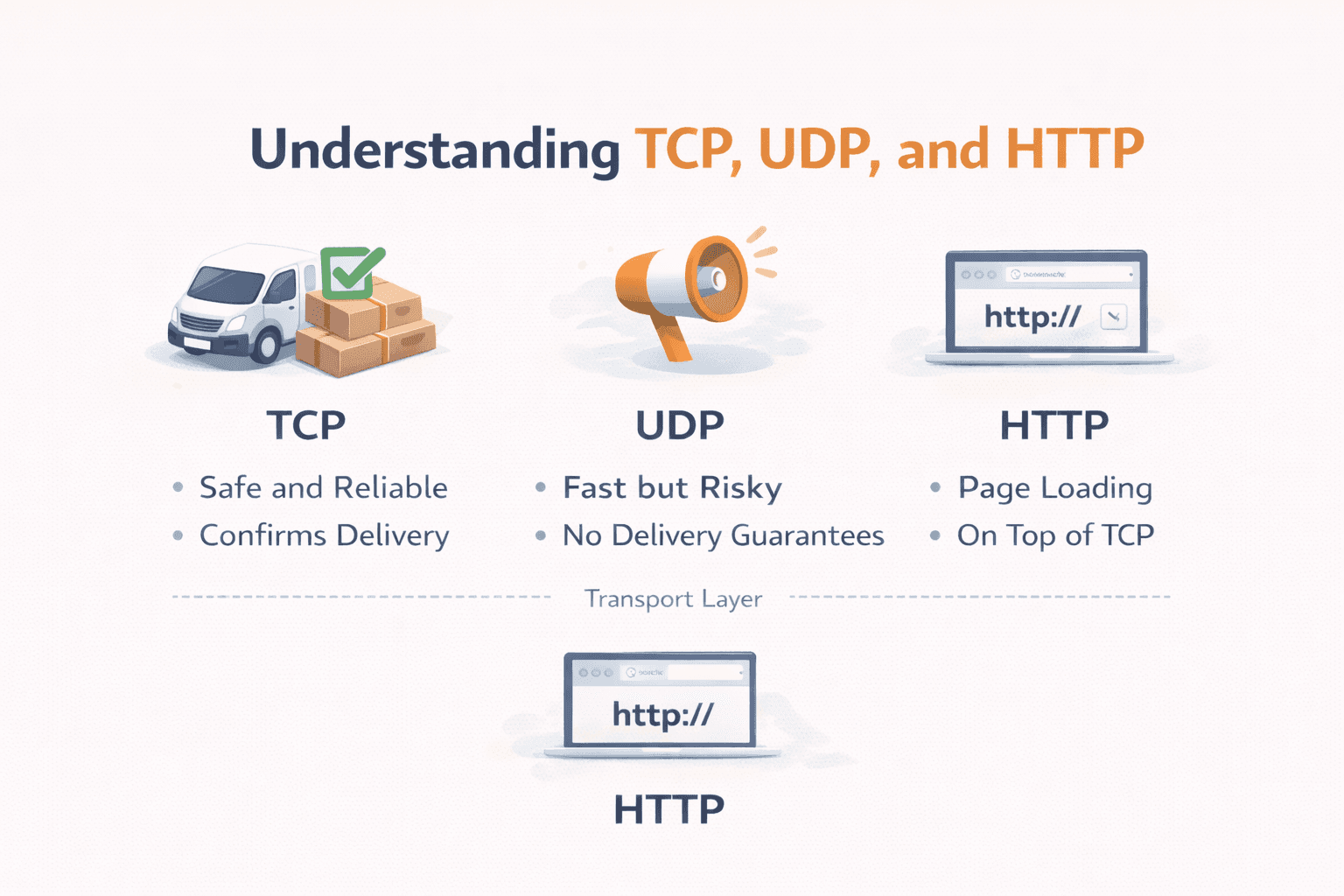
TCP: Safe and Reliable Data Delivery
TCP stands for Transmission Control Protocol.
TCP is used when data must arrive correctly and completely.
Before sending data, TCP first creates a connection between the sender and the receiver. Both sides agree to talk, just like starting a phone call.
While sending data, TCP:
Sends data in small pieces
Keeps track of every piece
Checks if data is received
Resends data if something is lost
Delivers data in the correct order
Because of all these checks, TCP is slower, but it is very reliable.
A simple analogy is a courier service:
Every package is tracked
Missing packages are resent
Order is preserved
Delivery confirmation exists
UDP: Fast but Risky Data Delivery
UDP stands for User Datagram Protocol.
UDP does not create a connection before sending data. It simply sends data and moves on.
UDP does not:
Check if data is received
Resend lost data
Guarantee order
Because of this, UDP is very fast, but not reliable.
A simple analogy is a live announcement:
Message is broadcast
If someone misses it, it is gone
No retries
Speed matters more than accuracy
UDP is used when speed is more important than perfection.
Key Differences Between TCP and UDP
TCP and UDP solve the same problem in different ways.
TCP focuses on:
Accuracy
Reliability
Order
Safety
UDP focuses on:
Speed
Low delay
Real time delivery
TCP waits and verifies.
UDP sends and forgets.
Neither is better overall.
Each exists for a different purpose.
When We Use TCP
We use TCP when losing data is not acceptable.
Examples include:
Loading a website
Sending emails
Downloading files
Online payments
APIs and backend communication
In these cases, even one missing piece of data can break the whole system. Speed is important, but correctness is more important.
That is why TCP is the default choice for most web related tasks.
When We Use UDP
We use UDP when real time speed matters more than perfect delivery.
Examples include:
Video calls
Live streaming
Online gaming
Voice calls
In these cases, it is better to lose a small amount of data than to wait. A delayed video frame is worse than a dropped one.
UDP keeps things fast and smooth, even if some data is lost.
Real World Examples: TCP vs UDP
To make this clearer, let us compare common real world usage.
Websites:
Use TCP
Because HTML, CSS, and JS must load correctly
Emails:
Use TCP
Because missing text is not acceptable
Video calls:
Use UDP
Because delay feels worse than data loss
Online games:
Use UDP
Because real time position updates matter
File downloads:
Use TCP
Because corrupted files are useless
What Is HTTP and Where It Fits
HTTP stands for HyperText Transfer Protocol.
HTTP is not a transport protocol.
It does not move data on the network by itself.
HTTP is an application level protocol.
Its job is to define:
How requests are made
How responses are structured
How browsers and servers talk in a meaningful way
HTTP defines things like:
GET and POST
Headers
Status codes
Request and response format
But HTTP does not care how data travels physically.
It relies on lower level protocols to do that job.
Relationship Between TCP and HTTP
HTTP runs on top of TCP.
This means:
TCP handles reliable data delivery
HTTP handles request response logic
When we open a website:
A TCP connection is created
HTTP request is sent over TCP
Server responds using HTTP
TCP ensures data arrives correctly
HTTP depends on TCP’s reliability.
Without TCP, HTTP would not work properly.
Why HTTP Does Not Replace TCP
This is a very common beginner confusion.
HTTP and TCP solve different problems.
TCP answers:
- How does data safely travel between computers?
HTTP answers:
What does this data mean?
Is this a request or a response?
What type of content is it?
HTTP cannot replace TCP because HTTP assumes that data delivery is already reliable.
That reliability comes from TCP.
Is HTTP the Same as TCP?
No, they are not the same.
A simple way to remember:
TCP is the road
HTTP is the traffic rules and signs
Without roads, rules are useless.
Without rules, roads are chaotic.
Both are required, but they exist at different layers.
Layering: The Big Picture
A simplified view of how things work:
Application Layer → HTTP
Transport Layer → TCP or UDP
Network Layer → IP
Each layer has a clear responsibility.
This separation makes the internet flexible, scalable, and reliable.
Final Summary
The internet needs rules to send data
TCP and UDP are transport level rules
TCP is safe and reliable
UDP is fast but risky
HTTP is an application level protocol
HTTP runs on top of TCP
HTTP does not replace TCP
TCP and HTTP are not the same
Understanding this foundation makes everything else in web development easier to learn.